What Is Sleep Apnoea?
Sleep apnoea is a potentially serious sleep disorder in which breathing repeatedly stops and starts. You might have sleep apnoea if you snore loudly and feel tired even after a whole night’s sleep.
The main types of sleep apnoea are:
- obstructive sleep apnoea, the more common form, which occurs when throat muscles relax
- central sleep apnoea, which occurs when your brain doesn’t send proper signals to breathing muscles
- complex sleep apnoea syndrome, also known as treatment-emergent central sleep apnoea, which occurs when someone has both obstructive sleep apnoea and central sleep apnoea.

Symptoms of Sleep Apnoea
Some of the symptoms of sleep apnoea include:
- poor-quality sleep with regular periods of reduced or absent breathing often accompanied by loud snoring and/or gasping for air
- daytime sleepiness and fatigue
- dry mouth and headaches upon waking
- poor concentration, poor memory, and slow reaction times
- irritability and mood changes
- depression and anxiety
- impotence (erectile dysfunction) and reduced sex drive (libido)
- need to get up to toilet frequently at night.
How Do You Know If You Might Have Sleep Apnoea?
Sleep apnoea may be noticed more by the bed partner than by the sleeper. Your bed partner might see that your breathing pauses, or they may complain of your loud snoring.
That said, although annoying, snoring isn’t the same as sleep apnoea. Snoring is just the vibration sound created by airway resistance. You can snore loudly and not have sleep apnoea, and you may even have sleep apnoea without much snoring.
People with sleep apnoea might also suffer from unexplained fatigue and mood swings because their breathing interruptions continually wake them and prevent them from settling into a deep, nourishing sleep. The consequences can be significant. People with sleep apnoea could get into car accidents in the daytime, lose productivity at work, have mood swings, wake up feeling groggy and fall asleep in class.
Other sufferers might wake up with a dry mouth since sleep apnoea makes you breathe with an open mouth, drying out your saliva. Some awaken with a headache, which may be caused by low oxygen or high carbon dioxide levels during sleep.
Can Sleep Apnoea Be Permanently Cured?
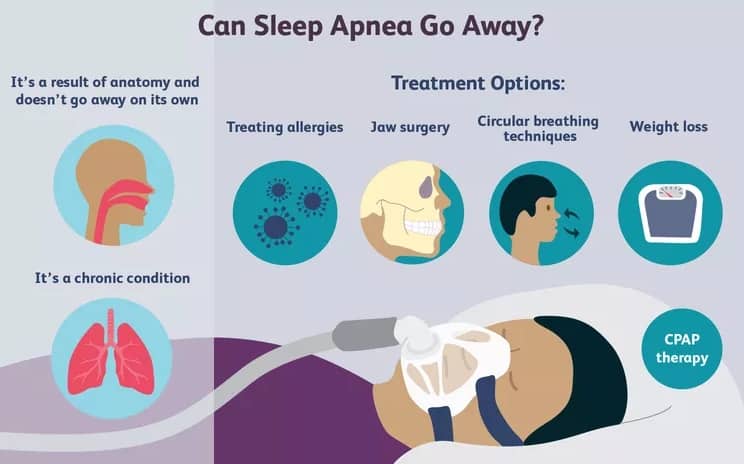
Because obstructive sleep apnoea results from anatomical characteristics, the question of a permanent cure is complicated to answer.
A CPAP machine or an oral appliance may treat ongoing sleep apnoea. A CPAP is worn nightly and works by opening the airway with air pressure. CPAP is effective for treating sleep apnoea, but many patients find it difficult or impossible to tolerate. Oral appliance therapy, which looks similar to a mouthguard or retainer and projects the jaw forward during sleep to open the airway, is another effective treatment generally considered more tolerable for patients. Both CPAP and oral appliances must be worn each night to achieve the desired outcomes for the patient. Yet, with consistent use, they can reduce a patient’s score on the apnoea-hypopnea index (which measures the number of pauses in breathing per hour) to less than 5, the number considered by doctors to mean a complete resolution of sleep apnoea.
Some surgeries for sleep apnoea can change a person’s anatomy, effectively curing the condition, at least in theory. However, success rates vary widely; in many cases, the condition returns, leaving patients disappointed.
Oral appliances and CPAP are the overall more reliable option, but for complicated cases, cases in which no other treatment has worked, or at the patient’s request, surgery may be the way to go.
Some surgical options for the treatment of sleep apnoea include:
- Uvulopalatopharyngoplasty (UPPP) — This surgery involves removing and/or repositioning various tissues in the mouth and throat to widen the airway, such as trimming the soft palate and uvula. This is the most common surgery for sleep apnoea; however, it is often combined with other surgeries, such as tonsillectomies (to remove the tonsils) and adenoidectomies (to remove the adenoids, the glands in the roof of the mouth).
- Septoplasty and Turbinate Reduction — These surgeries open the nasal passage to increase airflow.
- Genioglossus Advancement — This surgery involves pulling the base of the tongue forward to make the entire tongue firmer and less likely to collapse into the airway during sleep.
Can Sleep Apnoea Be Cured by Losing Weight?
According to research, there seems to be a significant correlation between obesity and sleep apnoea. Indeed, you may be more likely to suffer from an issue like this if you are overweight. However, not every patient who is obese will suffer from sleep apnoea. Similarly, not every sleep apnoea patient will be overweight. That said, if you are overweight, you should consider getting a physical examination. This will determine whether weight loss could help you. Typically, this will include measuring the circumference of the neck. Generally speaking, a circumference of 17 inches or higher in men and 16 inches in women will lead to a far greater chance of sleep apnoea.
If you are overweight, it is possible that losing weight will be enough to cure the condition completely. However, this won’t always be the case because anatomical factors can come into play. For instance, a person could have a receded chin, a deviated nasal septum or prominent tonsils. All these issues may cause some level of sleep apnoea and will not be corrected by significant levels of weight loss. That said, losing weight can have a variety of other benefits.
It can improve your joints, reduce issues with high blood pressure and provide a significant boost to your vitality. So, weight loss is certainly never going to be the wrong choice and definitely won’t make your sleep apnoea worse. It can only make it better.

Can an Adjustable Bed Help Solve Sleep Apnoea?
Elevating the upper body is one of the best ways to deal with sleep apnoea. An adjustable bed is a perfect solution to help achieve the required elevation for coping with sleep apnoea. Lying flat encourages collapsing of the airways, which happens during obstructive sleep apnoea, the most common subtype of this disorder.
An adjustable bed provides the support sleep apnoea patients need to remain in an upright position at night. Adjustable beds are electric beds that you can profile to different positions.
These beds use a multi-hinged structure, allowing you to move the upper and lower half of the bed independently of each other with simple remote control. Such control over the sleeping position with electric adjustable beds provides an excellent way for sleep apnoea patients to alleviate the symptoms of their disorder, limit snoring, and ensure better quality sleep.
An adjustable bed can complement other sleep apnoea treatments, such as CPAP machines, which are used as at-home treatments for this sleep disorder. Some patients might find that an electric adjustable bed solves most of their apnoea issues, but any potential discontinuation of other sleep apnoea treatments should always be discussed with your doctor. You can learn more about adjustable beds here.